Somebody told you SEO is dead and GEO is the new thing. Somebody else said GEO is just SEO with fresh paint. Both are half right, the most annoying kind of right.
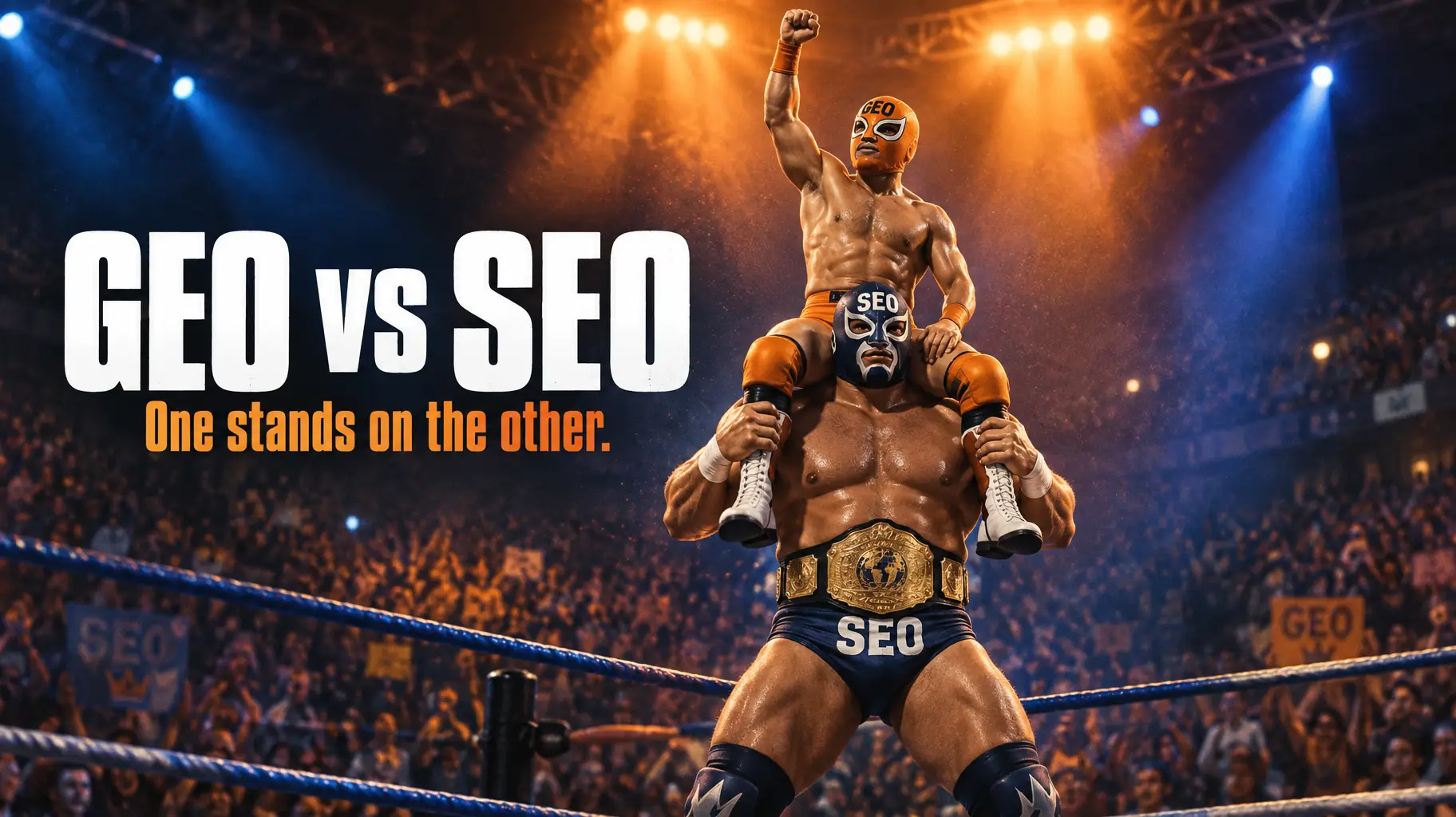
This guide settles the GEO vs SEO question in plain English for small business owners. You will learn what each term means, where they overlap, what GEO actually adds, and how to decide whether you need both. Short version: SEO is still the foundation. GEO is the floor you build on top of it.
What is SEO?
SEO (search engine optimization) is the work of getting your website to show up in traditional search results on Google and Bing. The goal is a ranking: your page listed when someone searches a phrase that matters to your business.
It has three main parts:
- Technical SEO: making sure search engines can crawl, render, and index your site. Fast pages, clean structure, a working sitemap.
- On-page SEO: writing pages that match what people search for, with clear titles, headings, and genuinely useful content.
- Off-page SEO: earning links, reviews, and mentions from other sites that signal you are legit.
Local businesses add local SEO: your Google Business Profile, reviews, and consistent name, address, and phone number everywhere. SEO wins you the click. That is the SEO half of the GEO vs SEO story.
What is GEO?
GEO (generative engine optimization) is the work of getting your business mentioned, quoted, or cited inside AI-generated answers. Think ChatGPT, Google AI Overviews, Gemini, Perplexity, and Copilot. Instead of a list of ten links, these tools write a single answer, and they pick which businesses and sources to name.
The term comes from a 2023 research paper called GEO: Generative Engine Optimization, written by Aggarwal, Murahari, Rajpurohit, Kalyan, Narasimhan, and Deshpande, a team from Princeton and collaborating institutions. They tested ways to shape content for generative engines and found that certain optimization methods could boost a source’s visibility in those AI responses by up to 40 percent. That is a research result, not a promise for your site. But it proved the point: structure changes whether AI picks your content up.
GEO wins you the mention. Sometimes the mention comes with a link. Sometimes it is just your name in a sentence, and the customer searches for you directly afterward. That shift from click to mention is the heart of GEO vs SEO.
What is AEO, and where does it fit?
AEO (answer engine optimization) is the practice of structuring content so a search engine or AI tool can lift a direct answer from it. It started with featured snippets and voice assistants, and it now overlaps heavily with GEO.
The simplest way to keep them straight:
- SEO gets your page ranked.
- AEO gets your answer pulled out and shown.
- GEO gets your business named and cited inside AI-written responses.
Most agencies (Two Dope Labs Media included) treat AEO and GEO as one workstream. The tactics are nearly identical: clear questions, direct answers, clean structure, and a business identity AI tools can trust. So when we talk about GEO vs SEO below, read AEO as riding along with GEO.
GEO vs SEO: a side-by-side comparison
The biggest difference in GEO vs SEO is the finish line. SEO aims for a ranking and a click. GEO aims for a mention inside an answer the customer may never click past.
| SEO | GEO | |
|---|---|---|
| Where you show up | Search results pages on Google and Bing | AI answers in ChatGPT, Google AI Overviews, Gemini, Perplexity, Copilot |
| What winning looks like | A top ranking and a click | Being named, quoted, or cited in the answer |
| Main unit | The web page | The business itself and the facts about it |
| Key signals | Relevance, links, technical health, reviews | Clarity, consistency, quotable answers, third-party mentions |
| How you measure it | Rankings, traffic, and conversions in analytics | Tracking prompts and recording who gets mentioned |
| Timeline | Months of steady work | Months, and it leans heavily on your SEO base |
| What it depends on | Crawlable, indexable pages | Everything SEO needs, plus entity clarity |
Read that last row twice. In the GEO vs SEO matchup, GEO stacks on top of the SEO column instead of replacing it.
GEO vs SEO: where they overlap (it is most of the work)
Most GEO sits on top of good SEO. If search engines cannot crawl your site, AI tools that pull from the web have a hard time finding you too, and AI tools that search the live web often start from a search index.
Here is what helps both at the same time:
- A crawlable, fast website. If bots cannot read the page, nobody quotes it.
- Clear service pages. One page per core service, written in plain language, answering what you do, who it is for, and where you do it.
- Reviews and reputation. Search rankings and AI answers both lean on what customers and other sites say about you.
- A strong Google Business Profile. It feeds local rankings and hands AI tools solid facts about your business.
- Helpful content that answers real questions. The same page that ranks for a question is a candidate to get quoted for it.
So when people frame GEO vs SEO as an either/or choice, they skip the part where the two share almost the same foundation. Pull out the SEO and GEO falls with it.
What GEO adds on top of SEO
This is where GEO vs SEO actually splits. GEO adds work aimed at how AI tools read and trust information. None of it is magic, and most small business sites skip all of it.
Entity clarity
An entity is a thing AI can identify with confidence: your business, its location, its services, its owner. Your site should state plainly who you are, what you do, and where you do it, ideally near the top of your homepage and again on your About page. Schema markup (structured data code that labels those facts for machines) helps reinforce it.
Content built to be quoted
AI tools love a clean, self-contained answer. That means question-style headings, a direct one or two sentence answer right under each one, then the detail. If your best answer is buried in paragraph six, it is hard to lift.
Third-party mentions
AI answers often reflect what the wider web says, not just what you say about yourself. Mentions in local news, industry associations, trusted directories, and review sites give AI tools more sources confirming you exist and do good work.
FAQ-style answers
A real FAQ section, written the way customers actually ask, does double duty. It covers long-tail search queries and gives AI engines quotable, standalone answers.
Consistent business info everywhere
Your name, address, phone, hours, and services should match across your website, Google Business Profile, Bing Places, Yelp, Facebook, and industry directories. Conflicting info makes AI tools hedge, and a hedging AI names somebody else.
Tracking prompts
Here is the most practical GEO vs SEO difference: rank tracking does not tell you whether ChatGPT recommends you. So you track prompts: the questions your customers type into AI tools, like “best roofer near me in Castle Rock” or “who does emergency water damage cleanup near Denver.” You run them on a schedule and record who gets named. It is imperfect, and it is still the honest way to see where you stand.
GEO vs SEO: do you need both?
For most small businesses, yes, but not in the order people pitch it. SEO comes first because GEO depends on it. Then GEO extends the reach of everything SEO built.
Use this quick decision guide:
- Your site has technical problems, thin service pages, or no Google Business Profile. Fix SEO first. GEO on a shaky foundation is wasted effort.
- You rank decently but never show up when you ask ChatGPT or Google’s AI about your service. You are ready for GEO. Your foundation is there. Your entity signals and quotable content are not.
- Your customers research heavily before buying (legal, medical, remodeling, B2B services). Prioritize GEO sooner. Those buyers ask AI tools long, specific questions.
- You sell to people with a quick, urgent, local need (a locksmith, a tow truck). SEO and your Google Business Profile carry most of the weight, though listings and reviews still help in AI answers.
- You have a tiny budget. Spend it on SEO fundamentals that also help GEO: service pages, FAQs, your Google Business Profile, and listing consistency.
The honest answer to GEO vs SEO is “SEO, then GEO, then both at once.” Anyone telling you to drop SEO for GEO is selling you something with a short shelf life.
How to start GEO without wrecking your SEO
You can begin GEO work this week without touching anything that already ranks. Add, do not rewrite.
- Ask the AI tools about yourself. Search your business name, and your main service plus your city, in ChatGPT, Gemini, Perplexity, and Google. Write down what they say and who they name.
- Fix your facts. Make sure your name, address, phone, hours, and service area match everywhere.
- Add a plain-language summary to your homepage. One or two sentences: who you are, what you do, where you do it.
- Add answer-first FAQs to your top service pages. Use the questions customers ask on the phone.
- Chase a few real mentions. A chamber of commerce listing, a supplier’s dealer page, a local news feature.
- Build a prompt list and check it monthly. Ten to twenty prompts is plenty to start.
None of those steps risks your rankings. Most improve them, which is the whole point of the GEO vs SEO conversation: done right, they pull in the same direction.
Frequently asked questions
What is the difference between GEO and SEO?
The GEO vs SEO difference comes down to the goal. SEO aims to rank your web pages in traditional search results on Google and Bing so people click through. GEO (generative engine optimization) aims to get your business named, quoted, or cited inside AI answers from ChatGPT, Gemini, Perplexity, and Google AI Overviews. SEO wins the click. GEO wins the mention. Most GEO work depends on a solid SEO foundation.
Is GEO replacing SEO?
No. In the GEO vs SEO debate, GEO builds on SEO rather than replacing it. AI tools that search the web still need to crawl and understand your pages, and many of them start from search indexes. Traditional search results also still drive calls, visits, and sales for small businesses. The smart move is to keep investing in SEO fundamentals and add GEO tactics on top, like entity clarity, FAQ content, and consistent listings.
What does GEO stand for?
GEO stands for generative engine optimization. The term was coined in a 2023 research paper by researchers from Princeton and collaborating institutions. It refers to shaping your content and online presence so generative AI tools, like ChatGPT, Gemini, Perplexity, and Google AI Overviews, are more likely to mention or cite your business in the answers they write for users.
What is AEO in marketing?
AEO stands for answer engine optimization. It is the practice of structuring content so search engines and AI tools can pull a direct answer from it, like a featured snippet, a voice assistant reply, or a line in an AI answer. AEO and GEO overlap heavily, and most agencies treat them as one workstream built on question-style headings and short, direct answers.
GEO vs SEO: which should a small business pay for first?
In the GEO vs SEO decision, SEO usually comes first. GEO relies on a crawlable site, clear service pages, reviews, and a complete Google Business Profile, which are all SEO fundamentals. Once those are solid, add GEO work like entity clarity, answer-first FAQs, consistent listings, and third-party mentions. Skipping straight to GEO on a weak site rarely pays off.
How do I know if my business shows up in AI answers?
Ask the AI tools directly. Type the questions your customers would ask, such as your service plus your city, into ChatGPT, Gemini, Perplexity, and Google. Record which businesses get named and whether yours appears. Repeat the same prompts every month so you can see changes over time. Answers vary, so look for patterns, not single results.
Can I do GEO and SEO at the same time?
Yes, once your site is technically sound. Most GEO tactics also improve SEO: clear service pages, answer-first FAQs, strong reviews, a complete Google Business Profile, and consistent business listings. The one thing to avoid is chasing GEO while ignoring serious SEO problems, like pages search engines cannot crawl or a site that loads slowly on phones.
How long does GEO take to work?
Expect months, not days. AI tools update how they see your business as they recrawl your site and find new mentions elsewhere on the web. Businesses with a strong SEO foundation tend to move sooner because the groundwork is done. Nobody can promise a specific timeline or guarantee that an AI tool will recommend you, so be wary of anyone who does.
Does schema markup help with GEO?
Schema markup can help. It is structured data code that labels facts on your page, like your business name, address, services, reviews, and FAQs, in a format machines read easily. That supports entity clarity, a core part of GEO. It is not a magic switch. Schema works best when your visible content already states those facts plainly.
Is GEO just a new name for SEO?
Not quite. GEO shares most of its foundation with SEO, which is why some people call it a rebrand. But GEO adds work SEO alone does not cover: making your business easy for AI to identify, writing content built to be quoted, earning third-party mentions, keeping listings consistent, and tracking prompts in AI tools instead of only tracking keyword rankings.
Stop guessing about GEO vs SEO
If you are still weighing GEO vs SEO for your business, let us look at both for you. Our AI search visibility services cover GEO and AEO on top of a real SEO foundation, and we start with a free audit that shows where you rank and where AI tools mention you. Book a call and get a straight answer, not a pitch.